
The cultivation of persimmon in areas where there are limiting factors such as the low rainfall, bad quality of the irrigation wáter, the insufficient permeability of the soil that avoids the infiltration of the irrigagtion and the use of fertilizers with excessive amounts of chloride, influence negatively in the expansion of this crop and in the agronomic conditions for the tree.
Therefore, it is very important to choose the right rootstock on which to graft a certain variety and also a good crop management. Traditionally, the persimmon has always been cultivated on the D. lotus rootstock, working very well in fertile lands with good physical-chemical properties, excellent climatology and good water quality.
As a result of climate change and the needs of the market to expand the commercialization of persimmon, it gives way to another well-known rootstock called D. virginiana that could be better adapted to areas where the climatic and soil conditions of the terrain are more extreme. D. virginiana gives to the farmer the possibility of placing this crop in warmer areas and with good management to extend the period of fruit harvesting.
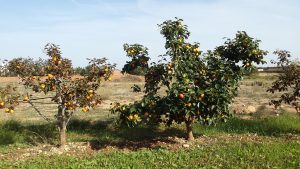
 PICTURE Nº1. PERSIMON WITH D. VIRGINIANA ROOTSTOCK. 14/12/2017. ALFARP TERM
The D. virginiana rootstock has a high vigor and is compatible with astringent and non-astringent varieties, presenting a root system formed by a strong and deep main taproot that gives it a resistance to drought optimizing the needs of irrigation and nutrition that are reduced by 50% respect to the D. lotus rootstock. The main quality of this rootstock is that it has a great resistance to chloride salinity. The sprouting and ripening of the fruit is the same for both rootstock, but in the case of D. Lotus rootstock, high concentrations of chloride influence the fruit negativily, with an earlier maturation followed by a lower penetrometry and firmness of fruit, thus reducing conservation, a factor that is very important for exportation. In addition, the process of eliminating astringency is less effective on the fruits more affected by salinity.
 PICTURE Nº2. CHLORIDE AFECTION TREE. 21/10/2014. ALFARP TERM
The tree on the left that corresponds to the D. Lotus rootstock, and it has lower vigour, less leaf density and size, burnt leaves borders and smaller fruit size are observed. The tree on the right correspond to the D. virginiana rootstock and it grows perfectly.
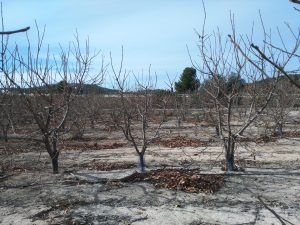 PICTURE Nº3. KAKI TONE WASE GROWING IN LIMESTONE SOIL. 11/12/2017. ROTGLÀ-CORBERÀ TERM
Another remarkable feature of D. virginiana is that it is tolerant to agrobacterium and limestone. The middle tree is D. lotus rootstock and the trees on the sides has D. virginiana rootstock. D. lotus rootstock has less vigour and teh reason is the high % of limestones that contains the soil.
The main drawbacks are that D. virginiana rootstock emits suckers from lateral roots, so it is not recomended of soil tillage, and is necessary to control the vigor through irrigation, pruning or authorized products.